
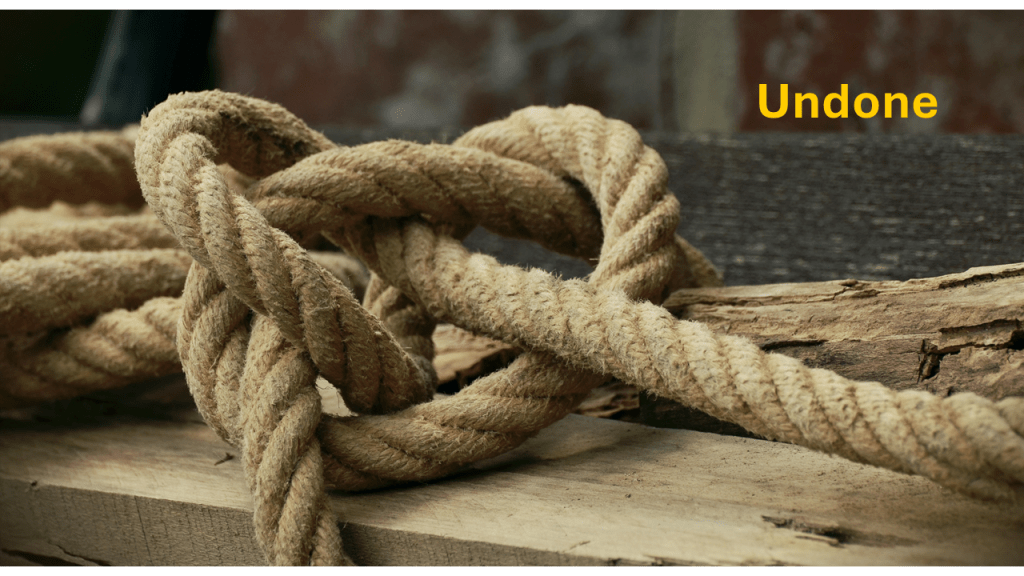
While walking around on the deck of our boat the other day, I noticed a line that had become “undone” and started to think about the word. What does it mean to become undone and how does it happen? If I had said it was “untied”, that might mean that I had untied it and would tie it again differently or even better.
I found it curious that the word had jumped out at me until I remembered why. When the prophet Isaiah saw the Lord in all his glory, he immediately responded, “Woe is me, for I am undone! Because I am a man of unclean lips, And I dwell in the midst of a people of unclean lips; For my eyes have seen the King, The Lord of hosts.” Isaiah 6:5 (NKJV) His next words were “here I am, send me.”
So to figure out what undone means I started by examining what it means to be “done”. For a knot to be done, it must contain the right tension and friction that make for a proper knot. Then I looked it up and found out that also the number of strands in the line and how they cross can have much to do with the effectiveness of the knot. By the way, Wikipedia says that a knot is “an intentional complication in cordage which may be practical or decorative, or both”.
To be “undone” then means the opposite. The knot has completely lost its way and can’t fix itself. It does not have the proper balance. It is pretty much useless. It needs someone to come along and put it to use again. It may have happened that under tension one of the strands failed or it was never tied properly in the first place.
So why was Isaiah undone? He had experienced the presence of God. There were other similar instances in Scripture. The Lord revealed himself to Moses on multiple occasions, but the first time was at the burning bush (Exodus 3); Moses responded by removing his shoes and hiding his face for he was afraid to look at God. The Lord revealed himself to Peter (Luke 5:8); Peter fell down and asked the Lord to depart because he was a sinful man. The Lord revealed himself to Paul on the road to Damascus; Paul saw a light so bright it knocked him off his horse and temporarily blinded him, causing him to cry out, “Who are you, Lord?” As with Isaiah, the Lord then commissioned each of these men for ministry and they obeyed.
There is no recorded case in Scripture where someone encountered the Lord and was not undone in some respect. So then is being undone a bad thing? Particularly in American culture, we are encouraged to view ourselves as done or at least always improving. American values. Hard work. Success. Worth. Self-Care. Identity. Pride. Purpose.
However, in the upside-down world of God’s Kingdom, it seems that undone is a great place to be. Think of the Beatitudes. Blessed are the meek, the poor, those who are persecuted, those who mourn. Why? I believe it is that when we are most empty of ourselves that we can be most filled of God.
Paul equates us to jars of clay “to show that the surpassing power belongs to God and not to us.” 2 Corinthians 4:7 (ESV).
Later in the same letter, he shares the personal story of his thorn in the flesh. When Paul pleaded with the Lord to take the thorn away, how does the Lord respond?
“My grace is sufficient for you, for my power is made perfect in weakness.”
And so Paul declared: “Therefore I will boast all the more gladly of my weaknesses, so that the power of Christ may rest upon me. For the sake of Christ, then, I am content with weaknesses, insults, hardships, persecutions, and calamities. For when I am weak, then I am strong.” 2 Corinthians 12:7-10 (ESV)
Again, it’s all upside-down. When we are undone in ourselves (and are hit with the realization that we fall short of the glory of God), then we are made done in Christ.
The Bible uses the word complete. “For in Him dwells all the fullness of the Godhead bodily; and you are complete in Him, who is the head of all principality and power.” Colossians 2:9-10 (NKJV)
If you look at the broad message of Scripture, man who had been made in the image of God enjoyed perfect friendship with God in the Garden. He was living for that which he was designed; he was complete. But he went from that glorious, complete state as a human being to utter alienation by sin, and sin was his undoing in the gravest of ways. Death entered the human experience, and try as he might, man couldn’t fix himself.
From then on, the story of an undone mankind marched toward the rescuing Messiah who emptied himself of all glory to be born with all our human limitations and weaknesses. The one sinless human humbled himself by becoming obedient to the point of death on the cross for us. (Philippians 2) He had done it perfectly.
Jesus was the only complete human being in and of himself, and by the cross, he began the work of restoring the Kingdom back to how it was in the Garden. Remember when Jesus said it is finished on the cross? Well, it turns out a lot was finished – all by faith in the only One who was able to do as He promised. Did you notice the verb tense in the Colossians verse above? You are complete in Him, the Word of God says.
This is the status of all Christians … now … in the present. It is how God the Father sees those who have faith in the Son.
“But now in Christ Jesus you who once were far off have been brought near by the blood of Christ. For he himself is our peace … (that he) might reconcile us both to God in one body through the cross.” Ephesians 2:13-14, 16 (ESV) He is our peace in our standing before God, but also as our peace, Jesus transforms who we are as a new creation.
Our American definition of peace is shallow compared to the Biblical meaning. Listen to some of these definitions that taken together round out the Hebrew understanding of a Shalom kind of peace: finished word, perfection, safety, satisfaction, contentment, soundness, harmony, wholeness, completeness. Jesus is our source of peace, and we are complete in Him.
And yet, too, we are being made complete. We do not always experience the fullness of that kind of peace, and yet it is a fruit of the Spirit (Galatians 3:22) as we grow more and more in the likeness of Jesus.
And finally, we will be complete. There is a phraseology coined by N.T. Wright that the kingdom of God is the already/not yet. The kingdom has already come through Jesus’s first coming, and yet the kingdom will come in full at his second coming. Revelation 21 says that at the fulfillment of the Kingdom in the new heaven and earth, every tear will be wiped away, and there will be no more death, mourning, crying or pain. We long for that day.
So, too, there is an already/not yet component to me. I am complete in Christ now, and yet I will be complete in Christ. When Christ returns again, the trumpet will sound, the dead will rise, and we will be changed. (1 Corinthians 5:52). I John 3:2 says that when Christ appears, we shall be like him for we shall see him as he is.
We will go from undone to done!
 Teleo
Teleo 